The Beauty Routine, Before the Bathroom Shelf
The beauty routine took shape through repeated habits, not matching bottles. Learn how daily schedules, household spaces and social expectations shaped its meaning.
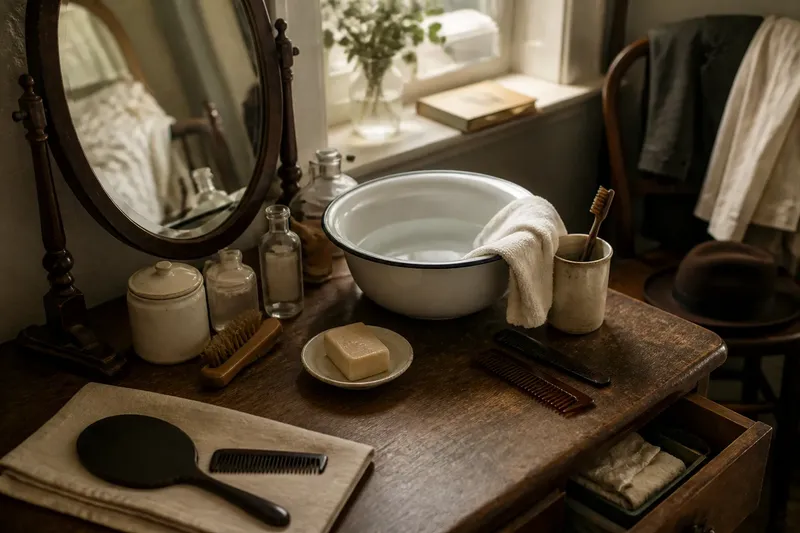
The most common mistake in the history of the beauty routine is to start with the bathroom shelf. That misses the more useful question: how did ordinary washing and grooming become a sequence people recognized as part of daily life?
Care before routines
People have washed, combed, dressed and scented themselves for many reasons: comfort, custom, preparation for work or public occasions, and ideas about appearance. The timing and setting varied with household resources and local habits. Care might be shared, fitted around domestic work, or spread across different rooms and moments.
Calling these acts a “routine” adds a particular frame. It suggests repetition, an order, and an individual who can manage the sequence. That frame is more informative than a list of products because it shows how care was fitted into a day.
Daily schedules
There was no single invention or turning point that made grooming regular. Schedules, access to washing facilities, expectations at work and in public, and the availability of manufactured goods all shaped how people prepared themselves. Their influence differed across places and households, so a broad historical account should avoid treating one household pattern as universal.
Imagine a clerk whose washing and grooming had previously happened whenever household duties allowed. In this invented situation, a more predictable work departure prompts the clerk to set aside the same stretch of time before leaving and to comb their hair after washing. The observable result is a repeated order tied to the workday, not evidence of a new product or a universal historical sequence.
To understand a routine, look at the daily transition it serves: waking, dressing, leaving home, or preparing for rest.
Spaces and supplies
A private washing space could make it easier to keep water, combs, soap or other supplies together and to prepare in a predictable place. But homes differed, and personal care also took place in bedrooms, shared spaces, or wherever a household could manage it. A bathroom could support a routine; it did not create the habit by itself.
Mirrors, storage and lighting can make particular tasks more convenient. They also help create a familiar image of grooming as private, orderly preparation. That image is only one arrangement among many, not a reliable picture of how everyone cared for themselves.
Personal expectations
Advice about grooming increasingly addressed people as individuals, encouraging them to consider their own face, hair, schedule or social role. Consumer messaging could connect those habits to particular goods and present a sequence as something a person might assemble through purchases. That language helped make personal care easier to describe as a set of repeatable actions, without making every routine identical.
These expectations were not neutral. Ideas about looking clean, polished or respectable varied with gender, class, occupation and community. A routine could offer practical order, while also carrying pressure to meet standards set by other people.
It helps to separate a useful personal habit from an instruction that presents one appearance as compulsory.
Questions about routines?
Was a beauty routine always about appearance?
No. Washing and grooming can serve comfort, cleanliness, custom and preparation for work or public life as well as appearance. A beauty routine may combine several of these purposes.
Did advertising invent the routine?
No; people washed, dressed and groomed before those acts were packaged as consumer rituals. Advertising could connect familiar actions to products and encourage a particular sequence, but it was not the origin of personal care.
Why do routines differ between households?
Available time, space, water, household responsibilities and local expectations all affect what a person can repeat. A sequence that fits one household may be impractical in another.
When does care become a beauty ritual?
There is no single dividing moment. The term usually signals that repeated care is being framed as a personal sequence connected to appearance, even when it also serves practical purposes.
Reading the habit
The phrase “beauty routine” can describe a habit, an ideal, or a product-led sequence, and those meanings are not interchangeable. Ask what moment the sequence serves, which actions are practical, and whose expectations shape it. This makes the history easier to read without assuming every person followed the same pattern.
The beauty routine is best understood through its order and purpose, not the objects gathered in one room. When a routine feels compulsory, notice whether it solves a real need in your day or mainly repeats someone else’s standard.